AI Text Rewriter vs. AI Humanizer: What's the Difference (And Why You Need Both)
Every week, millions of people paste AI-generated drafts into a rewriting tool hoping to make them sound more natural. Students, marketers, freelance writers, and content teams all face the same problem: AI writing tools like ChatGPT, Claude, and Gemini are fast, but the output often reads flat, repetitive, and unmistakably machine-made. That's where an AI text rewriter and an AI humanizer come in - two tools that solve related but distinct problems.
If you've ever wondered which one you actually need, or whether a single tool can do both, this guide breaks it down.
What Is an AI Text Rewriter?
An AI text rewriter takes existing text - whether it's AI-generated or written by a human - and restructures it. It changes sentence order, swaps vocabulary, adjusts phrasing, and improves flow, all while keeping the original meaning intact. Think of it as an editor that never gets tired: paste in a paragraph, choose how much you want it changed, and get back a version that reads more clearly.
A good rewriter typically offers a few levels of intensity:
- Light rewriting - small adjustments, ideal for text that's already close to how you want it
- Medium rewriting - noticeable restructuring of sentences and word choice, the right default for most drafts
- Aggressive rewriting - the deepest changes to structure, vocabulary, and flow, useful when text needs a substantial overhaul
This flexibility matters because not every piece of writing needs the same treatment. A polished email might need light touch-ups, while a rough AI-generated outline might need aggressive restructuring before it's publish-ready.
What Is an AI Humanizer?
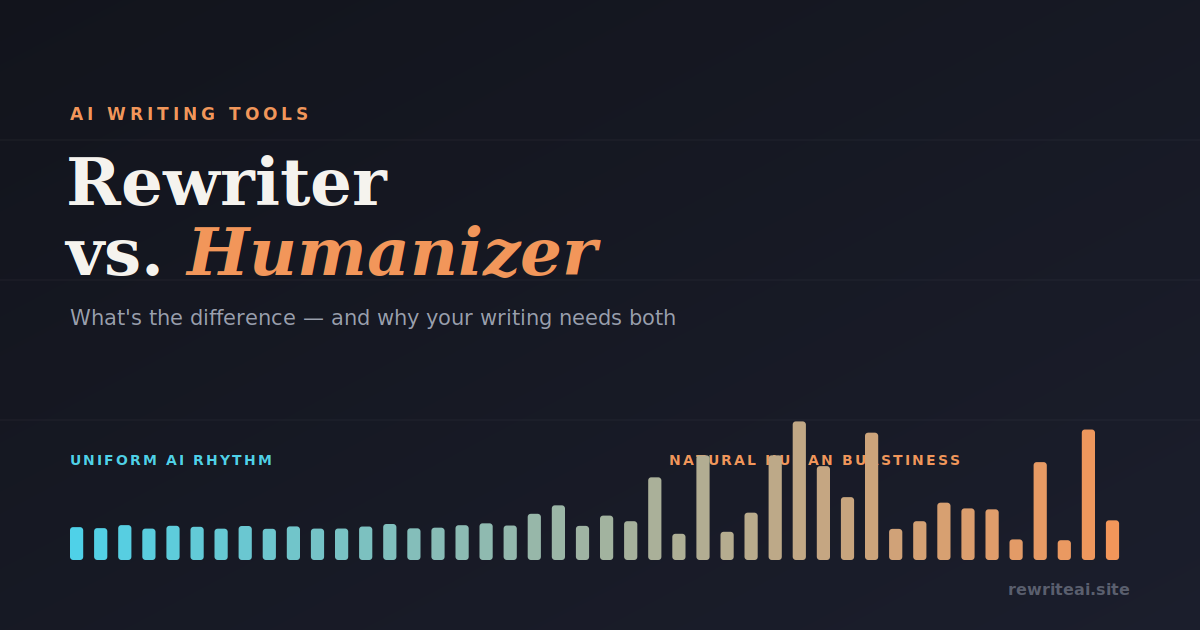
An AI humanizer is a specialized type of rewriter built specifically to address one problem: text that reads as obviously AI-generated. Language models tend to produce writing with predictable rhythms - sentences of similar length, common transition words, and vocabulary that clusters around the "safest" next word. That consistency is efficient for generating text quickly, but it creates a signature that both careful readers and AI detection tools can pick up on.
An AI humanizer studies those patterns and deliberately breaks them. It varies sentence length, introduces natural rhythm, and adjusts word choice so the final text reads the way a person actually writes - with occasional short sentences, unexpected phrasing, and the kind of variation that comes naturally to human thought but rarely shows up in raw AI output.
Two technical terms are worth knowing here:
- Perplexity measures how predictable each word is, given the words before it. AI text tends to score low, meaning it's highly predictable.
- Burstiness measures how much sentence length and complexity vary across a passage. Human writing tends to be "burstier," mixing short and long sentences unpredictably.
A strong humanizer adjusts both of these signals, not just vocabulary, which is why simple synonym-swapping tools tend to fail against modern AI detectors while a proper humanizer holds up much better.
Rewriter vs. Humanizer: The Key Difference
| AI Text Rewriter | AI Humanizer | |
|---|---|---|
| Main goal | Improve clarity, flow, and tone | Reduce AI-detection signals |
| Best for | Editing any draft, human or AI-written | Text that needs to pass AI detection tools |
| Focus | Sentence structure and readability | Perplexity and burstiness patterns |
| Typical users | Writers, marketers, editors | Students, content creators publishing AI-assisted work |
In practice, the line between the two has blurred. Modern tools like RewriteAI combine both functions in one workspace: you can rewrite a paragraph for clarity and readability, and the same engine handles the sentence-variation work that makes text read more naturally and score better against AI detectors - without you needing to run it through two separate tools.
Why Word-for-Word Synonym Swaps Don't Work Anymore
Early paraphrasing tools worked by replacing words with synonyms while leaving sentence structure untouched. This approach is easy to spot, both by human readers ("why does this sentence use such an odd word choice?") and by detection algorithms, which look at structural patterns rather than just vocabulary.
A rewriter that only swaps words leaves the underlying skeleton of the AI-generated sentence intact - the same clause order, the same transitions, the same rhythm. Real restructuring means reordering clauses, combining short sentences into longer ones (or vice versa), and changing how ideas connect from one sentence to the next. That's a fundamentally different, and more effective, approach than a thesaurus-style swap.
How to Check If Your Rewritten Text Actually Reads as Human
Rewriting text without checking the result is a bit like editing a document without proofreading it. The most reliable workflow looks like this:
- Paste your draft into a rewriter and choose an intensity level based on how much change it needs.
- Run the rewritten output through an AI detector that checks against multiple detection models rather than just one, since no single detector is fully accurate on its own.
- Review the AI-probability score and re-run a heavier rewrite mode if the text still scores high.
- Read it aloud - this catches awkward phrasing that a detector might miss but a human reader would notice immediately.
Tools that bundle a rewriter, humanizer, and detector into a single workspace make this loop much faster, since you're not exporting text between three different apps.
Keeping Your SEO Keywords Intact While Humanizing
If you're rewriting content for a blog, product page, or landing page, there's an extra wrinkle: you can't afford to lose the exact keyword phrases you're targeting for search rankings. A rewriter that changes every instance of "AI text rewriter" to "text rewriting software" might read more naturally, but it could quietly undermine months of SEO work.
The better approach is keyword locking - telling the rewriting engine which specific terms or phrases must stay exactly as written, while it reworks everything around them. This lets you get natural-sounding, human-quality content without sacrificing the search terms your page depends on.
Who Actually Uses These Tools?
- Students run drafts through a rewriter and detector before submission, especially when AI-assisted research needs to read in their own voice.
- Content marketers and bloggers turn AI-generated outlines into finished, publish-ready posts that don't sound generated.
- Non-native English speakers use rewriters to smooth out phrasing that's technically correct but doesn't sound quite natural.
- Agencies and content teams use API access to run rewriting and detection automatically across large volumes of content, rather than checking each piece by hand.
A Note on Using These Tools Responsibly
AI rewriters and humanizers are best treated as part of an honest editing process - a way to make your own writing (or AI-assisted drafts) clearer, more natural, and easier to read. Many schools and publications have specific policies on AI-assisted writing and disclosure, so it's worth checking those before submitting rewritten text in a context where transparency matters. Used thoughtfully, these tools are about improving how ideas are expressed, not misrepresenting where they came from.
Choosing the Right Tool
If you only need to polish grammar and phrasing, a basic rewriter will do the job. But if your text needs to hold up against AI detection - for an academic submission, a client deliverable, or published content - you need a tool built specifically for humanizing, with a detector built in so you can verify the result rather than guess at it.
Tools like RewriteAI combine an AI rewriter, humanizer, and multi-model AI detector in one workspace, with keyword locking for SEO content and support for over 20 languages - so you can rewrite, check, and confirm your text is ready to publish without switching between five different apps.
Ready to try it yourself? Paste your text into RewriteAI's free humanizer and see the difference in seconds - no sign-up required.