The Complete Guide to Humanizing AI-Generated Content in 2026 (Without Losing Your Voice)
AI writing tools have changed how fast content gets made - but speed created a new problem. Search engines, professors, editors, and even casual readers have gotten noticeably better at spotting text that came out of a language model. A flat rhythm, over-explained transitions, and vocabulary that always reaches for the "safest" word are dead giveaways.
This guide walks through what actually makes AI text sound like AI, how detection tools measure it, and a practical, step-by-step process for turning a rough AI draft into something that reads like it was written by a person who knows the subject - because most of the time, that person is you, and the AI just helped you get the first draft down faster.
Key Takeaways
- AI detectors mainly measure two signals: perplexity (word predictability) and burstiness (sentence-length variation) - not just vocabulary choice.
- Synonym-swapping alone rarely works, because it doesn't change sentence structure or rhythm, which is what detectors actually analyze.
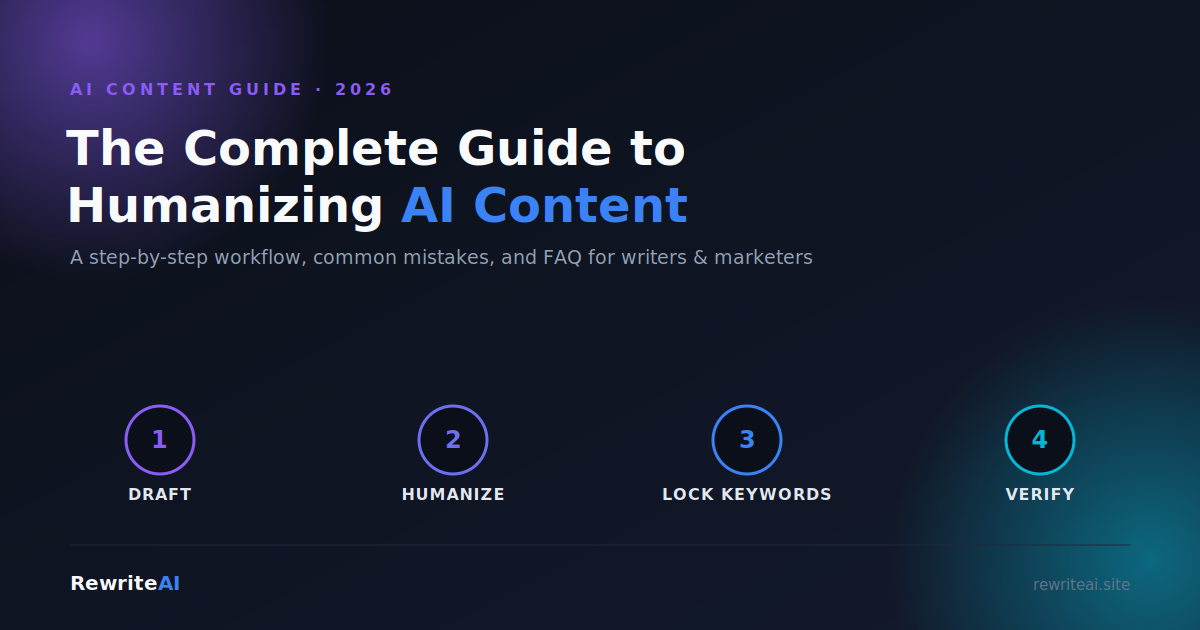
- A reliable workflow is: draft -> humanize -> lock keywords -> verify with a detector -> refine, not a single one-shot rewrite.
- Humanizing should never come at the cost of your target SEO keywords - keyword locking solves this.
- The goal isn't to "trick" anyone - it's to close the gap between technically correct text and writing that genuinely sounds like you.
Table of Contents
- Why It Matters More Than Ever in 2026
- How AI Detectors Actually Work
- The Most Common Mistakes When Humanizing AI Text
- A Practical Workflow: From AI Draft to Publish-Ready Text
- Manual Editing vs. AI Humanizer Tools
- Humanizing for Different Types of Content
- SEO and Humanized Content: What to Watch For
- Using These Tools Responsibly
- Frequently Asked Questions
Why It Matters More Than Ever in 2026
A few things have converged this year that make humanizing AI content less optional than it used to be:
- Search engines reward originality. Google's helpful content systems are tuned to favor pages that demonstrate real experience and a distinct point of view, not generic, templated writing that reads the same as every other page targeting the same keyword.
- AI detectors have gotten more accurate - and more common. Universities, publishers, and content platforms increasingly run submissions through detection tools before they're accepted, and false accusations are a real risk for anyone whose natural writing style happens to be clean and consistent.
- Readers notice. Even without a formal detector, people can usually tell when a blog post, email, or product description was clearly AI-generated and not reviewed. It reads as impersonal, and it erodes trust faster than a typo would.
- Platforms are adding disclosure requirements. Some publications and marketplaces now ask contributors to disclose AI assistance, which makes it more important than ever that AI-assisted writing genuinely reflects the writer's own voice and judgment, not just a generated first draft passed through unchanged.
None of this means AI-assisted writing is a problem. It means the finishing step - making the output sound like you - has become part of the job, not an optional polish.
How AI Detectors Actually Work
Most AI detection tools don't "understand" text the way a person does. Instead, they measure statistical patterns that tend to differ between machine-generated and human-written text. Two concepts matter most:
Perplexity measures how predictable each word is, given everything that came before it. Language models are trained to produce the most statistically likely next word, so AI text tends to have low perplexity - it flows in a way that's technically correct but a little too smooth and expected. Human writing has higher perplexity because people occasionally choose a less common word, take a stylistic detour, or phrase something in a slightly unexpected way.
Burstiness measures how much sentence length and structure vary across a passage. Humans naturally mix short, punchy sentences with longer, more complex ones - often without thinking about it. AI-generated text tends to settle into a rhythm: similar sentence lengths, similar structures, paragraph after paragraph. That uniformity is efficient for a model to generate, but it's also one of the clearest fingerprints detectors look for.
Some detectors also check for watermarking signals - subtle statistical patterns some AI providers intentionally embed in generated text - though this is less standardized across models and providers than perplexity and burstiness analysis.
Understanding these two signals explains why simple find-and-replace paraphrasing tools don't hold up: swapping words for synonyms doesn't change sentence rhythm or structure, which is exactly what detectors are measuring.
The Most Common Mistakes When Humanizing AI Text
Relying on synonym-swapping alone. A tool that just replaces words with alternatives (often producing slightly awkward substitutions) leaves the sentence skeleton untouched. Detectors look at structure, not just vocabulary, so this approach rarely works on its own.
Over-humanizing until it sounds unnatural. Pushing a rewriting tool to its most aggressive setting can sometimes introduce phrasing that's too quirky or informal for the content's actual context. A LinkedIn post and a technical support article need different registers, even if both need to avoid sounding robotic.
Losing your target keywords in the process. This is a big one for anyone publishing content for search traffic. If a rewriting tool changes every instance of your primary keyword phrase to a synonym for the sake of variety, you can quietly tank the SEO value of a page while "fixing" its tone.
Skipping verification. Rewriting text and assuming it will pass detection is a guess, not a check. Running the output through an actual AI detector - ideally one that checks against multiple detection models rather than just one - turns that guess into a confirmed result.
Not reading it out loud. This sounds basic, but it's the fastest way to catch phrasing that a detector might miss and a human reader would notice immediately. If a sentence feels clunky to say, it probably reads that way too.
A Practical Workflow: From AI Draft to Publish-Ready Text
Here's a process that works well whether you're finishing a blog post, a client email, or an academic assignment:
1. Generate your first draft with AI, but write your own outline first. Content that starts from your own structure and argument, with AI filling in the language, reads more naturally than content where the AI decided the structure too. This single step does more for authenticity than any rewriting tool.
2. Run the draft through an AI humanizer. A tool like RewriteAI's humanizer restructures sentences, varies rhythm, and adjusts word choice to raise perplexity and burstiness - the two signals detectors actually measure - rather than just swapping synonyms.
3. Choose the right rewrite intensity for the content type. Light rewriting works for text that's already close to your voice. Medium is the right default for most first drafts. Aggressive rewriting suits AI output that reads especially flat or generic and needs a deeper restructuring pass.
4. Lock your target keywords before rewriting, if SEO matters. If you're optimizing for search, tell your rewriting tool which exact phrases must stay untouched. This lets the engine rework everything around those terms without diluting the keyword targeting you're relying on for rankings.
5. Check the result with an AI detector. Paste the rewritten text into RewriteAI's AI detector, which checks against multiple detection models and returns an aggregate score - a more reliable read than trusting any single detector, since no one model is fully accurate on its own.
6. Re-run a heavier pass if the score is still high. If the AI-probability score comes back high, don't just tweak a few words manually - go back to the rewriter and increase the intensity, or manually rewrite the sections that scored worst.
7. Read it aloud, one more time. Before publishing or submitting, read the final version aloud. This catches the small awkward spots that both AI generation and rewriting tools can leave behind.
Manual Editing vs. AI Humanizer Tools
A common question is whether it's worth using a dedicated tool at all, versus just editing the draft by hand. Both have a place - here's how they actually compare:
| Manual Editing | AI Humanizer Tool | |
|---|---|---|
| Speed | Slow - every sentence reworked by hand | Fast - full draft processed in seconds |
| Consistency | Varies with editor fatigue and skill | Consistent structural changes every time |
| Detection accuracy | Depends entirely on the editor's instinct | Directly targets perplexity and burstiness signals |
| Keyword control | Full control, but easy to lose track across a long draft | Keyword locking preserves exact target phrases automatically |
| Best used for | Adding personal examples, opinions, and expertise | The structural and rhythm work detectors actually measure |
In practice, the strongest results come from combining both: let a tool like RewriteAI handle the structural rewriting, then spend your own editing time adding the specific details, examples, and opinions that only you can provide.
Humanizing for Different Types of Content
Academic writing. Precision matters more than personality here. Focus on varying sentence structure and cutting AI's tendency to over-explain simple points, while keeping technical vocabulary intact. Always check your institution's policy on AI-assisted writing and disclosure before submitting anything that started as AI output.
Blog posts and articles. This is where voice matters most. Aggressive humanizing plus a manual pass to add specific examples, personal framing, or opinions (things a generic AI draft won't include on its own) makes the biggest difference in both readability and how "human" the piece feels to actual readers.
Marketing and sales copy. Persuasive writing depends on rhythm and confidence. Bursty, varied sentence length reads as more natural and more convincing than the evenly-paced, over-qualified tone AI models often default to.
Emails and internal communication. These usually need lighter humanizing since the stakes for sounding "too polished" are different. But watch for AI's habit of adding unnecessary preamble ("I hope this email finds you well") that a person writing quickly usually skips.
Multilingual content. If you're writing or rewriting in a language other than English, make sure your tool actually supports that language's grammar and idiom patterns rather than just translating English humanizing rules. RewriteAI supports over 20 languages for exactly this reason - sentence rhythm and word predictability work differently across languages, and a one-size-fits-all English-trained humanizer won't catch that.
SEO and Humanized Content: What to Watch For
Google's own guidance has consistently focused on whether content is helpful and demonstrates real expertise, not on whether it was typed by a human or generated with AI assistance. In practice, that means the humanizing process should be judged by the same standard as any edit: does it make the content clearer, more specific, and more useful, not just less detectable?
A few practical points:
- Don't sacrifice keyword targeting for the sake of variety. Use keyword locking if your rewriting tool supports it, so your primary and secondary keywords survive the rewrite intact.
- Add specifics an AI wouldn't know. Real examples, your own data, direct quotes from your own experience - these are exactly the things that separate genuinely useful content from generic AI output, and no rewriting tool can add them for you.
- Keep headings scannable. Humanizing shouldn't mean losing the clear H2/H3 structure that both readers and search engines use to understand a page's content.
- Don't over-optimize into robotic repetition. Repeating an exact-match keyword phrase unnaturally often reads as more AI-like, not less - natural language variation around a locked core term usually performs better with both readers and modern ranking systems.
The safest SEO strategy for AI-assisted content isn't hiding that AI was involved - it's making sure the final piece is genuinely more useful than what a reader would find elsewhere.
Using These Tools Responsibly
AI humanizers and detectors work best as part of an honest editing process, not a way to misrepresent where content came from. If you're a student, check your school's specific policy on AI assistance and disclosure before submitting anything. If you're publishing professionally, many outlets now have their own AI-use guidelines worth reviewing first. Used well, these tools help you say what you already meant to say, more clearly and in your own voice - they're not a substitute for having something worth saying in the first place.
Frequently Asked Questions
Does humanizing AI text guarantee it will pass every AI detector? No single tool can guarantee that, because detectors vary in what they measure and how they're trained. The most reliable approach is to rewrite for genuine sentence-level variation, then verify with a multi-model detector rather than assuming a pass.
Is it better to write from scratch or humanize AI output? For content where your personal expertise or opinion is the main value (like a personal blog or a nuanced analysis), starting from your own outline and using AI for a first pass on language usually produces more authentic results than generating a full draft and heavily rewriting it afterward.
Will humanizing hurt my SEO rankings? Not if done correctly. The risk isn't the humanizing itself - it's losing target keywords during the rewrite. Locking your key phrases before running a rewrite avoids this problem entirely.
How do I know which rewrite intensity to use? Start with medium intensity for most drafts, check the result with a detector, and only move to aggressive rewriting if the score is still high or the text still reads noticeably flat.
Can I use a humanizer for languages other than English? Yes, as long as the tool is actually built to handle that language's grammar and rhythm patterns rather than applying English-specific rules. RewriteAI supports more than 20 languages for this reason.
How often should I re-check content after publishing? AI detection models get updated periodically, so if a page is especially important for search traffic or academic credit, it's worth re-checking it every few months rather than assuming a single pass at publish time is permanent.
Final Thoughts
The goal of humanizing AI-generated content was never to trick anyone - it's to close the gap between "technically correct" and "actually sounds like a person wrote it with care." That gap is exactly what perplexity and burstiness measure, and it's exactly what a good rewriting and detection workflow fixes.
If you want to try the full workflow described here - rewriting, humanizing, and multi-model detection in one place - RewriteAI offers all three, along with keyword locking for SEO content and support for over 20 languages. You can also compare plans on the pricing page or browse more guides like this one on the RewriteAI blog.